Try MushGPT!
 Your payment is protected
THANK YOU!
We sincerely appreciate your generous donation to Entheology Project Inc. As a 508(c)(1)(a) non-profit religious organization, your donation is tax deductible. You will receive an email confirmation for your records, which can be used for tax purposes. Your support helps us continue our mission and make a meaningful impact!
Billing Information
Your credit card will be billed under "Entheology Project Inc." with the description "Donation." If you have any questions or need further assistance, please do not hesitate to contact us. Thank you once again for your support!
Best Regards,
EP Support
help@entheo.info
Looks like there was a problem processing donation.
What Is EntheoDNA? The Science Behind Personalized Psychedelic Pharmacogenomics
By Rev
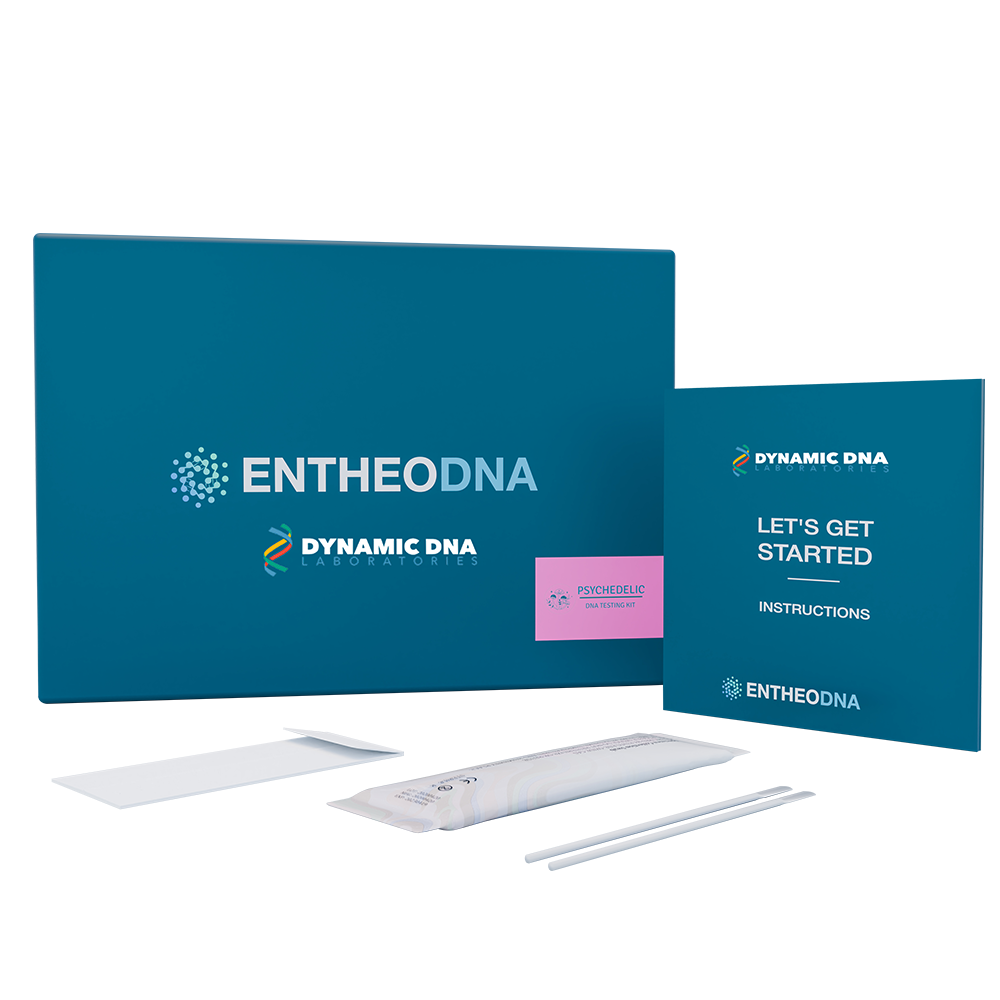
Know before you dose. Knowing your sensitivities before the trip.
As scientific interest in psychedelic-assisted therapies continues to grow, one question is becoming increasingly important:
Why do two people taking the same substance under similar conditions sometimes have dramatically different experiences?
The answer is complex. Set, setting, mental health, medications, expectations, physical health, and experience all influence outcomes. Yet one often-overlooked factor is genetics.
The field that studies how inherited DNA influences responses to medications and other biologically active compounds is known as pharmacogenomics.
EntheoDNA applies pharmacogenomic principles specifically to psychedelic and entheogenic compounds, providing educational information that may help people better understand their own biological tendencies before participating in legal, medical, research, or therapeutic contexts.
What Is EntheoDNA?
EntheoDNA is an educational pharmacogenomic DNA test developed specifically to analyze inherited genetic variants that may influence responses to psychedelic and psychoactive substances.
Unlike ancestry testing or general wellness DNA kits, EntheoDNA focuses on genes associated with:
- Drug metabolism
- Serotonin receptor biology
- Neuroplasticity
- Drug transport proteins
- Drug-gene interactions
- Medication interaction awareness
The test uses a painless cheek swab collected at home and analyzed by Dynamic DNA Laboratories, a CAP-accredited, CLIA-certified laboratory.
Results are delivered through an interactive online report and downloadable PDF designed to explain relative biological tendencies—not certainty.
Why Genetics Matter
Every person inherits small differences in DNA called genetic variants.
Many of these variants have no obvious effect.
Others influence proteins responsible for:
- breaking down medications
- transporting drugs into tissues
- regulating neurotransmitters
- responding to serotonin
- supporting neuroplasticity
These differences help explain why one individual may metabolize a compound rapidly while another processes it much more slowly.
For psychedelic compounds, this may influence:
- duration of effects
- blood concentrations
- receptor sensitivity
- medication interactions
- adverse event risk
Importantly, genetics represent one piece of a much larger picture.
They do not determine whether someone will have a positive or negative psychedelic experience.
The Difference Between Pharmacokinetics and Pharmacodynamics
EntheoDNA evaluates both major components of drug response.
Pharmacokinetics
Pharmacokinetics describes what the body does to a substance.
This includes:
- absorption
- metabolism
- distribution
- elimination
Genes involved include:
- CYP2D6
- CYP2B6
- CYP2C9
- CYP3A4
- MAO-A
Some individuals metabolize certain compounds significantly slower than others.
Pharmacodynamics
Pharmacodynamics describes what the substance does to the body.
This includes receptor activation, neurotransmitter signaling, and downstream biological responses.
Genes include:
- HTR2A
- HTR1A
- BDNF
- SLC6A2
- ABCB1
- ABCG2
- AKT1
Together these provide a more complete picture of biological variability.
Substances Covered
EntheoDNA currently provides educational information related to:
- Psilocybin
- LSD
- MDMA
- DMT
- Ayahuasca
- 5-MeO-DMT
- Ketamine
- Ibogaine
- Mescaline
- Salvia divinorum
- Cannabis
Key Genes Included
CYP2D6
Perhaps the most important pharmacogenomic gene currently studied in psychedelic research.
Research demonstrates CYP2D6 substantially influences metabolism of compounds including:
- LSD
- MDMA
- Ibogaine
- 5-MeO-DMT metabolites
Individuals with reduced CYP2D6 activity may experience:
- longer duration
- higher blood concentrations
- increased biological exposure
Several clinical studies have demonstrated significantly altered LSD pharmacokinetics among CYP2D6 poor metabolizers.
HTR2A
HTR2A encodes the serotonin 2A receptor—the primary receptor responsible for many classical psychedelic effects.
Variants may influence receptor sensitivity and individual variability, although current evidence remains an active area of research.
MAO-A
Monoamine oxidase A plays an important role in metabolizing several naturally occurring monoamines and compounds relevant to ayahuasca and 5-MeO-DMT.
Understanding MAO-A biology is particularly important when considering potential medication interactions.
BDNF
Brain-derived neurotrophic factor supports neuroplasticity, learning, and synaptic adaptation.
Research investigating ketamine and psychedelic-assisted therapies increasingly examines BDNF signaling as part of therapeutic response.
Drug Transport Proteins
Genes including:
- ABCB1
- ABCG2
- SLC6A2
help regulate how compounds move throughout the body and nervous system.
Why EntheoDNA Is Different
General consumer DNA tests such as 23andMe and AncestryDNA primarily focus on ancestry and broad wellness traits.
EntheoDNA focuses specifically on pharmacogenomic factors relevant to psychedelic compounds.
The report integrates current scientific literature to provide educational summaries of:
- metabolism
- receptor biology
- potential medication interactions
- relative biological tendencies
rather than ancestry information.
What the Test Does NOT Do
EntheoDNA does not:
- predict psychedelic experiences
- guarantee safety
- recommend dosage
- diagnose disease
- replace medical care
- encourage psychedelic use
Instead, it provides educational information intended to support informed preparation and harm reduction.
Harm Reduction Through Knowledge
Understanding inherited biology may help individuals ask better questions before participating in legal or medically supervised experiences.
Examples include:
- Could certain medications interact?
- Might metabolism differ from average?
- Are additional medical discussions appropriate?
- Should healthcare providers know about specific pharmacogenomic findings?
The report is designed to encourage thoughtful preparation—not certainty.
Privacy
Privacy is central to the EntheoDNA platform.
Features include:
- pseudonymous EntheoID identifiers
- HIPAA-aligned privacy practices
- secure laboratory processing
- no sale of genetic information
- deletion available upon request
The Science Continues to Evolve
Psychedelic pharmacogenomics remains a rapidly developing scientific field.
New discoveries continue to improve understanding of:
- CYP450 metabolism
- serotonin receptor biology
- neuroplasticity
- transporter proteins
- pharmacodynamic variability
As evidence grows, educational resources like EntheoDNA can evolve alongside the research.
Scientific Foundation
EntheoDNA is informed by peer-reviewed pharmacogenomic research including studies on:
- CYP2D6 influence on LSD pharmacokinetics
- MDMA pharmacogenetics
- Ibogaine metabolism
- Ketamine pharmacogenetics
- 5-MeO-DMT metabolism
- Cannabis pharmacogenomics
- Psilocybin neuroplasticity
- Mescaline receptor pharmacology
- Drug-drug interaction research
- Cytochrome P450 pharmacology
Scientific findings continue to evolve. EntheoDNA reports reflect the current evidence base while emphasizing uncertainty where appropriate.
Learn More
EntheoDNA Home Kit
https://entheo.info/product/entheodna-home-kit/
Disclaimer
EntheoDNA is an educational pharmacogenomic risk-awareness product intended to support harm reduction and informed preparation.
It is not FDA-approved and is not intended to diagnose, treat, cure, or prevent any disease.
EntheoDNA does not encourage, promote, or recommend the use of controlled substances. Many substances discussed are illegal in numerous jurisdictions. Users should comply with all applicable laws and consult qualified healthcare professionals before making health-related decisions.